Thursday, February 26, 2015

Mission San Antonio Part 4


Mission San Jose y San Miguel de Aguayo,  was called Mission San Jose or "Queen of the Missions" because of its size and number of Indians living there. Father Margil de Jesus, a Franciscan missionary living in the Alamo, saw a need for a new mission. He requested permission from the governor of the Province of Coahulila and Texas to build a new mission in San Antonio. Permission was granted and they started building on February 23 1720.

The church is on the left and the guest quarters are on the right

The church construction began in 1768 and at that time there were 350 Indians living in 84 two room apartments. The Friars jobs were to convert the Indians into Catholic, tax-paying subjects of the King of Spain. As in all the missions the Indians had many changes to entail, including changing their names and learning two languages, Latin and Spanish. Their lives in the mission also included church bells that called them to worship three times a day. There were over 2000 Indians baptized in the 104 years that San Jose was a mission.

The Indian`s apartments

On February 29, 1824 San Jose ceased to remain a mission. Complying with orders from the Mexican government, the mission was fully secularized. Father Diaz turned the mission over to the Indians that were living there and Chaplain Maynes. The mission was neglected and fell into ruins following the Benedictines, Redemptorists, and the Holy Cross Fathers ministering there. The Franciscans returned in 1931 and are still there currently.

The side of the church with the Rose Window

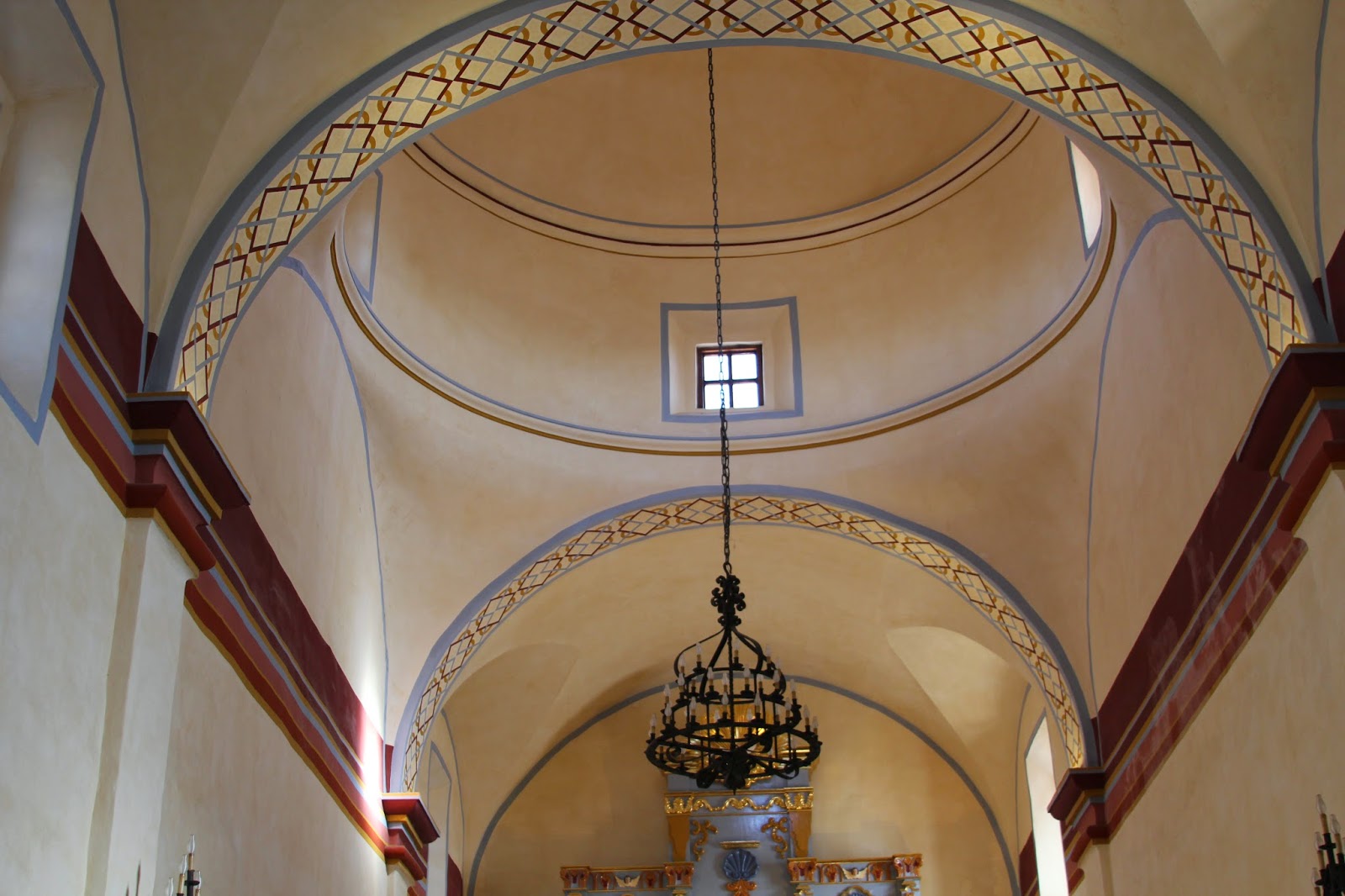
The chapel in the Mission is very ornate and there is gold everywhere. The religious statues are beautiful and the ceiling is gorgeous. The beauty continues outside the enormous wood door with the carvings and architecture around the entrance.

The Chapel in Mission San Jose.
The Alter up close.
Ceiling in the Chapel.
Carving around the Entrance to the Church

There is a window on the side of the church called the Rose Window. They say it is a premier example of Spanish Colonial ornamentation in the US. They do not know who sculpted the window or why. The folklore about the window says that Pedro Huizar, a carpenter and surveyor from Spain, was waiting for his sweetheart, Rosa, to join him from Spain. On her journey Rosa was lost at sea. Pedro then carved the window as a declaration of his love. The more reasonable and less romantic theory is that it was named after the first saint of the New World, Saint Rosa of Lima.  Personally, I am going with the love story.

Rose Window

In the back of the Mission was a Grist Mill that was functioning in 1794 when the people of the mission were eating more than corn and wheat. The mill ran on the water from the irrigation system and aqueducts.

The Mill at Mission San Jose
The water system that worked the mill

This was my favorite of the missions. It was the largest, most intact, and it had a gift shop!


Monday, February 23, 2015

Hockey Stick Headboard

My youngest son has been playing hockey for close to 20 years. He is a senior in college and will have one more year of eligibility before it is off to Men's league. I think he would be a great coach one day, and I know that he will always ice skate.

When we moved to Indianapolis, from Fort Wayne, our son was in the 7th grade and I decided to make him a hockey headboard. We still use it today with a quilt that was made with all his jerseys and t- shirts from all the teams he has played for.


To make the headboard I bought a package of mite orange sticks and 4 adult sticks. All the sticks are wood. I cut the small sticks just at the end of the Sher-Wood label and the large sticks to the length that worked for the bed.


I laid the small sticks on the floor face side down in the pattern I wanted, and then laid the large stick on top of them spacing them in the pattern I liked. You can then put a dab of hot glue to hold them in place in between the spot where they intersect. I just got out the drill and drilled a hole through the back of the large stick and part way into the small stick. I then screwed the pieces together.  I drilled holes through the large sticks in four inconspicuous spots to screw them into anchors in the wall. It was all very easy!


The headboard started out on a twin bed and is now on a queen. They both looked great!

Friday, February 20, 2015

Hockey Weekend

Last weekend my Husband and I made the journey to the Midwest to watch our Son play college hockey. We went from sunny Texas to the freezing Midwest and saw three great games of hockey. This was the first time we have seen our son play this year, and we were not disappointed.  We were supposed to make the same journey last October, but he broke his arm in September, so we had to postpone the trip until this February. After being out for 4 months, and only back playing for 3 weeks, he looks to be back at 100%. I really missed seeing him play and was so glad he is back playing the game he loves.

This is the only picture we have of our Son during the first half of the season. 

My husband took pictures all weekend, and my Son's girlfriend and I  sat in the stands and watched three awesome games. I have sat in hockey ice rinks for the last 18 years, and this rink is one of the only ones that actually had the heaters working above the stands. I cannot tell you how many games I have left and needed to thaw out. Since it was 4 degrees outside with a wind chill of -30 it was nice to not freeze while inside too.

Three games played and three games won. Each game unique with the first a regulation win, the second an overtime win, and the third a shootout win. Like I said, three great games of hockey.

Our Son plays defense and has the perfect personality for the position, because nothing said to him gets under his skin, Yet, he certainly knows how to get under the opponent`s skin. His "signature" in front of the net is to push down on the back of the opponents pants. It is very effective and the other player tends to move out of the way, or risk maybe losing his pants, lol.
Pushing down on the back of the pants is a effective move.

The only person that gets to my Son, and everyone else, is the Referee. There is nothing worse in any sport than when poor refereeing can change the outcome of any game. There were certainly some questionable calls, one of the refs went a little ballistic on some of the college fans during the first game. In the second game one of the Refs shoved a player which is not OK, but most of the calls were maybe one sided, but did not change the outcome of the games.

I am sure the Referee is complimenting our Son on how well he is playing

For many this was the best play of the game

After the third game we went straight to the airport for our trip home. When we arrived home it was in the mid 60`s. I love Texas!

Thursday, February 5, 2015

Mission San Antonio: Part 3


Mission San Juan Capistrano was the third Mission on our tour. Originally built in East Texas in 1716 this mission was called Mission San Jose de los Nazonis to serve the Nazonis Indians. Because they were not successful, they moved the mission to the San Antonio River and renamed it San Juan Capistrano on March 5, 1731.

Map of Mission San Juan Capistrano.

The mission had serious battles with epidemics of smallpox, measles and other European diseases along with being terrorized by bands of Apaches and Comanches. The mission still grew, and by 1762 there were 203 Indians living in the mission. The Indians were very industrious, and with a granary and textile shops, along with the aqueduct for watering, agriculture became the basis of their economy. The crops they grew included corn, beans, sweet potatoes, chilies, melons, cotton, sugar cane and squash. Outside the walls of the mission were orchards that grew peaches, pumpkins and grapes too. In 1762 there was said to have been around 3500 sheep and almost as many cattle at the mission. This was all possible because of the fertile soil, and the water supply from the irrigation system.


The church was constructed in 1772 and the exterior is covered with plaster. It was weather stained, cracking and in need of better support beams. The chapel went through a stabilization and preservation project in 2012 and was covered in an eggshell white plaster.


San Juan is still an active church and services are still held here. This would be such a neat place to be married. In the year 2000, three Spanish Colonial period pieces were stolen from the alter. These 3-4 foot statues are painted carved wood. These artifacts are not considered priceless because of their value as art, and they were not carved by someone famous, but they are priceless because of their religious history, and their importance to the people of the mission.


This was the site of an unfinished church started in 1780. In the Ruins lies the remains of the indigenous people that built the mission. The sign reads "Sacred Earth".


The chapel at this mission looks so beautiful with the white plaster. My husband took his favorite picture above with the sun behind the bell towers. Screen Saver!

Next Stop, Mission San Jose

Tuesday, January 27, 2015

Military History Went Up In Smoke

Sunday evening I told my husband that I was going to work on getting information on my Dad`s military history this week. On Monday afternoon I started my search, and was very upset to find the following posting on the National Archives website:


What is devastating about this post is that 80% of the Army records were destroyed in this fire, and they cover the years my Dad served in WWII. I will still try to get his records in hopes that maybe they are the lucky 20% that survived. In the picture above you can see the sentence, under the box, that says there were no duplicate copies nor were there microfilms made of these records.

The post does go on to say that they have been trying to recreate the lost and damaged information. The preservation team has been dealing with records that have been burned, waterlogged and have had to go through mold remediation. They have had about 40 years to work on it, so maybe I will have a little luck and be able to get some information from their hard work.

Today is the 70th anniversary of the liberation of Auschwitz. The Russian soldiers that liberated Auschwitz hold a special place in history. How sad would it be if the military records no longer existed for the family members of soldiers that may have played very important roles in the American`s liberation of camps like Dachau. The Americans were responsible for the liberation of several camps, and these soldier`s records may have been lost forever. There are so many Americans that came home from WWII and did not share their stories. They saw unbelievable human devastation and lived in a generation that just did not talk about their experiences, thoughts and feelings. The loss of these records will  make it impossible for these soldier`s ancestors to ever learn of their experiences.

My Dad enlisted at the end of the war, and he told a story that after his basic training he was sent home for a short period of time due to complications during the birth of my oldest sister. His unit was shipped out overseas, and he told us that they all lost their lives soon after their deployment. When he reported back to to the base he was sent to the Aleutian Islands to serve until the end of the war. I would love to be able to verify this story by tracking his original unit and the one he finally joined. Due to the damaged files I may never get the answers I am looking for. It may have all gone up in a puff of smoke.

Monday, January 19, 2015

Mission San Antonio: Part 2

The second mission we visited in San Antonio was Mission San Francisco de la Espada (Mission Saint Francis of the Sword).

Map of the Mission San Francisco de la Espanda.

Espada had several locations in east Texas before it settled on the current location along the San Antonio River on March 5, 1731. This site became a merging of cultures that had to overcome language, values and faith differences. The Missionaries took the Coahuiltecan (kwa-weel-teken) people (a collective name for many small bands of Indians that lived in southern Texas adjacent to Mexico) and over a 50 year period taught these hunter and gatherers the principals of farming, ranching, architecture, blacksmithing, loom weaving, spinning and masonry. Espada was the only San Antonio mission that actually made bricks and tiles in the mission.


These are the ruins of the Indian quarters to the left of the Mission`s entrance.
The Coalhuiltecans were fighting famine, diseases, and enemy tribes on their own, so they chose the protection and plentiful food supply of the mission. These people embraced the Spanish life and Christianity. In 1794, Espanda started the transformation to a church-based community. Also, at this time the mission was impoverished, and there were only 15 families left that received land and shared equipment and supplies from the mission. In 1826, the Comanches raided the cornfields and killed the livestock, and that same year a kitchen fire destroyed most of the buildings. The chapel survived and people continued to make Espada their home. Today the church still serves as the heart of the community and mission descendants still worship there.


The above ruins were the granary in 1762 and was converted to a church in 1773-76. The existing church below was built in 1740 and the bell tower was added in the 1780s.

There is currently work being done to preserve the chapel.
Daily training and tasks were accomplished to the timing of the missions bells in the tower.
The Mission`s Acequia System was essential for the success of the survival of the missions crops. Because of the sparse rainfall in the San Antonio region there had to be a irrigation system put into place to make farming successful. The missionaries and natives created a seven gravity flow ditch system called acequias. Five dams and several aqueducts along the San Antonio River supplied a constant flow of river water into the system. The 15 mile system irrigated about 3500 acres of land.

The water moved through this aqueduct by gravity.
The acesquia system in Espanda is the best preserved, and the oldest Spanish aqueduct in the United States. The aqueduct was completed in 1745 and still diverts river water via the Espanda Aqueduct, using gravity and floodgates, to fields for irrigation, bathing and washing for farms today.


This is a picture of the water flowing over the canal bridge pictured below. There was also a creek running under the canal bridge.


This was such a successful system, and is in great shape for being over 250 years old.

Stay tuned for Mission San Antonio part 3. Are you learning anything?

Thursday, January 15, 2015

Mission San Antonio Part 1

Road trip to San Antonio!  My husband and I love to be tourists and since we were going to Austin for a race, we decided to spend a few days in San Antonio. This city is one of Texas` most famous tourist spots. Remember the Alamo?  Well we will never forget it! We went to see this historic site right after we checked into the hotel. This is such a significant site in the road to Texas becoming part of the United States.

The missions on the San Antonio River were built in the 1700`s and forms the largest concentration of Catholic missions in North America. The Spanish explorers from New Spain (Mexico) traveled north across the Rio Grande in search of riches. As they traveled east they encountered the Tejas Indians for whom Texas was named. When the dream of riches faded the Spanish concentrated on spreading the Catholic faith among the frontier Indians.  The Missions were both an agent of the church and the Mexican government by converting the the Indians, and by pushing the empire northward.

The Alamo was originally built on the Rio Grande, but later moved to the San Antonio River due to threats by the French in Louisiana.

Mission San Antonio de Valero "The Alamo"

The Alamo (Mission San Antonio de Valero) was the first mission on the San Antonio River. It was founded in 1718 and is most famous for the Battle of the Alamo in February and March of 1836. President Antonio Santa Anna led the Mexican army to the Alamo and embarked on a 13 day battle that killed all of the Texan defenders. These defenders included the famous Davy Crockett. The cruelty of Santa Anna inspired many Texas settlers to join the Texan army and fight for independence. The Texans defeated the Mexican Army at the Battle of San Jacinto on April 21, 1836 and ended the revolution.


The bodies of the Alamo Heroes were moved and buried in a tomb in the Cathedral of San Fernando. 


The above picture shows the apartments at the Alamo where the Indians lived. The natives in the area  that were taken in by the Friers of the mission, were not only converted spiritually, but were given clothes, taught how to farm, and how to fight to help defend the mission from other tribes that were not as friendly, or interested in becoming a part of the mission.

San Antonio is also famous for the river walk. The river walk is like a canal system that goes through the city that is beautifully landscaped, littered with cool bridges, inhabited by many wonderful restaurants, shops, hotels, and taxi/tour boats.  We took the boat tour at night and loved it. Then, the next day we walked the entire river walk and were able to take pictures of all the spots they told us about on the boat tour.


This is just one of the views on the river walk where you can see a restaurant in the background.


The landscaping along the river walk is breathtaking in many areas. We took the boat tour in the evening and it was really beautiful to see the city all lit up while on the water.


The picture above shows a tour boat or water taxi. It was a great way to see and learn about the city. We were told that the river was designed with dams and locks so that they can drain the river and clean it of all the sunglasses, flip flops and other items that are dropped into the river. They do this maintenance in January of odd numbered years.


After the flood in 1921, you could see the water line on the old buildings along the river walk, the tree in the wall above started to grow after that flood.

We checked out of the hotel at 2pm and wanted to do the mission tour before we left for Austin. Now there are five missions on the tour including the Alamo. Since we had already seen the Alamo, we had four to go. The only problem was that they all close at 5pm and we had to drive about 17 miles to get to the first one. So we had four Missions to see, and also an Aqueduct to visit. Talk about your quick tour.

I will do a few more blogs on the missions, because the pictures are so wonderful and I want to be able to share as many as I can with you.


Grandma's Quilt

  My Paternal Grandma was a quilter. I mean a hardcore, full size, wood frame, hand sewn quilter. I remember as a kid in the 60s and 70s goi...