Monday, March 21, 2022

Wreaths Across America

 My Father In-law was buried in the Dallas-Fort Worth National Cemetery in 2020. We had just moved into our new house a few month earlier, and when talking to one of our new neighbors, a Veteran, he told us about Wreaths Across America. He told us that we could volunteer to help lay wreaths on the graves in the National Cemetery. I was too late for 2020, but we volunteered for 2021.

Waiting during the ceremony.

My husband and I, along with our daughter and grandkids, were going to go out to the cemetery on December 18, 2021 to volunteer for the event. As with everything in our lives, it just wasn't going to be that simple. I broke my foot and was in a boot, so I was not able to attend and my granddaughter could not attend. So, my husband, daughter and grandson ventured off early on a cold, windy Texas day to volunteer.

Having never attended this special day, a lot was learned on this first visit. First, thousands of people volunteer for this event to lay 48,000 plus wreaths. Parking was crazy. My family had to park in the median of the 4 lane road outside of the cemetery and walk a few miles to just get into the property. Then there was a lot of waiting. Waiting in high cold winds without shelter several miles from the car.

The street where the car was parked and everyone walking to the entrance.

The organizers hold a ceremony first full of pomp and circumstance including a military fly over. Then boxes with the wreaths were positioned on the roads around the property for each section of this very large cemetery. The volunteers are given the wreaths and instruction. When they lay the wreath on the grave, they say the name of the Veteran on the headstone. They can also say a thank you for their service if they want. My Grandson asked his Papa if he could lay the wreath on his Great Grandfather's grave. Obviously the answer was yes, and my husband said it was very emotional and special. Our grandson laid the wreath, kneeled down in front of the headstone, and fluffed and straightened the bow. Our Grandson was very proud of his Great Grandfather's Service and even wrote about him during last years Veterans Day celebration at school.


My family continued laying wreaths, saying the names of the Veterans and thanking them for their service. Although it was a long wait to get started, and because there were so many people participating, each person only had to lay about a dozen wreaths a piece. This event left a huge impact on our family.

My Father In-law's section was complete.

The definition of a wreath is a band of intertwined flowers or leaves worn as a mark of honor or victory. As a country our leaders lay wreaths on many military tombs, and this event is no different. This is not a religious or a holiday event, it is a Patriotic event to honor the service of our Veterans. 

Our visit on January 12, 2022

My husband and I went back to the Cemetery before the wreaths were removed. Even after a month of unseasonably warm weather and no rain, the wreaths were a bit brown and worn, but still gave us such a feeling of pride. It is a wonderful way to recognize the service of these Patriots during a time of year when people are so self absorbed. What better time of the year than December, the end of the year, to thank these selfless Men and Women who risked their lives for another year of our freedom.

Monday, February 21, 2022

Easy Indoor Christmas Decorations

2020 Christmas wall.
Two small paintings I covered.

I have a wall in my dinning room full of family pictures. When I was decorating for Christmas last year I had a great idea to decorate my picture wall. Instead of replacing the current pictures with Christmas pictures, I decided to just wrap the current pictures like presents.

Pictures in 2021


I had some metal star ornaments, bows, wood snowflake ornaments, small pinecones and ice cycle ornaments to decorate the picture presents.  In 2020 I picked a color scheme of red, green, blue and silver. I had Merry Christmas, red and green cloth ribbon to use on the project. I kept all of the ribbon and ornaments after I used them in 2020 and used them again on my new color scheme in 2021. The new color scheme was red, black, silver and gold.

I made sure I bought quality wrapping paper so it would hold up to the sharp corners of the frames. I also used hot glue to hold the ornaments to the front of the picture presents. The ribbon is held in place on the back of the frame with blue painter's tape.

The pictures above were taken at an angle which made the pictures look like they were crooked, they are not. I hate crooked pictures, so I am barely stopping myself from deleting the pictures, lol.

When Christmas is over, you get to unwrap extra presents off the wall and enjoy the pictures that had been hiding behind the Christmas wrap all month.

I love the look of the decorated wall in front of my decorated table. It was very festive.

My large poinsettia is missing from this picture. They were very hard to find here last Christmas. I received one as a gift  (Thanks Lynn) and put it in the snowman hat. 

If you don't have a picture wall, you can wrap all the pictures in a room or even the whole house. It is an inexpensive and pretty way to decorate for the Holiday. It is also a great way to decorate at a business or office. Happy wrapping!


Tuesday, February 8, 2022

The Worst Candles Ever

Many years ago we started celebrating Hanukkah. We had an antique menorah that we acquired when we were younger and started a new tradition. I admit that we don't celebrate Hanukkah in a religious way, like we celebrate Christmas, but we always light a menorah each year. Hanukkah is a minor Jewish holiday, but the story is a great story of religious freedom. You don't have to be Jewish to celebrate the meaning of The Festival of Lights. There was a war, about 200 years before the birth of Christ, between Antiochus the ruler of the Greek Kingdom and the Jewish citizens. When Antiochus destroyed the Jewish Second Temple and imposed pagan beliefs for all his people, like worshiping statues of Zeus, or sacrificing pigs at the alter of that Temple, the Jews rebelled. The Jewish warriors were called Maccabees, led by a Jewish Priest named Mattathias and his 5 sons. They were the first Jews to defend their religious beliefs. When Mattathias was killed, his son Judah became the leader. After the War was won, Judah and the Maccabees restored the Second Temple. Because there must be a light burning in the Temple at all times, when they were rededicating the temple they only had enough olive oil to light the menorah for one day. By a miracle the oil burned for eight nights giving them time to find more oil. Great story no matter what religion you are.

This is what Hanukkah candles are not suppose to look like when they are burning.

Now that the history lesson is over, let's talk about candles. Each year I buy candles, and always late by like a day or two before I need them. Never a good plan because they are not easy to find. I usually buy them at Target, or a grocery store. In 2020 I think I bought them at a grocery store. 

This was after about 5 days and the unidentified box of terrible candles.

The tradition is to light one candle the first night, two the second night, and so on until you are up to eight on the eighth night. There is one extra candle each night, the middle candle called the Shamash,  that is lit first. You use the Shamash to light the rest of the candles from right to left like Hebrew is read. This is a lot of Jewish history from a Christian girl just to complain about candles, lol.

This was half way through night 6. Already a nice size pile of "wax"
 and the menorah is a mess.

So, in 2020  I lit the candles, and unlike every other Hanukkah night for the last 30 some years, they didn't melt correctly. Normally, the candles barely leave any wax residue anywhere. This was a crazy mess. I kept the drippings on the plastic place mat I had the menorah on just to see how much wax I would end up with. I was not disappointed. 

The end of day 8. The large pile of "wax" was bad enough, but trying to clean
 the menorah and removing all the drippings on the metal was a nightmare.
 I felt like it was its own miracle that I got all the 'wax" off. 

This was a long way to go to complain about terrible candles. But, if  y'all learned something about history, religious freedom, miracles, or just terrible candles, it was worth it. Shalom.

Thursday, February 3, 2022

Our Junk Drawer Inheritance

My Dad passed away in 2010 and my Mom in 2015. They left behind a house full of stuff. My Mom kept everything! Luckily, I have six siblings which made the clean out a bit easier. We went through boxes and boxes of "treasures". Boxes of McDonalds Happy Meal toys, dishes, paintings, pictures, videos, tools, craft supplies, books, family history items, papers and papers and papers!! One thing my parents had plenty of was junk drawers. Not just in the kitchen either. 

On a visit to Florida to my sister Lynn's house, my sister Jean and I were there to do some family craft projects. We had already started on the wood project we were doing with planks from my Grandma's old house. On this day Lynn brought out boxes of our parent's junk drawer's contents. Included in the boxes were a hodgepodge of costume jewelry. There were hair curlers with picks, thimbles, stamps, pictures, pearls, keys, old credit cards from a store that had long been closed, broaches, buttons, earrings, pictures of old relatives and school pictures of cousins, coins, bowling award pins, plastic watches, board game pieces, cufflinks ...............

A few of the pieces in my inheritance jar.

We bought large mason jars, one for each sibling. We lined them up and picked one of each item for each jar. There were some items that were one, or two of a kind, that went to the sibling that it would have meant the most to. My oldest siblings got the roller skate keys, or a thimble may have gone to a sibling that sewed. All the junk that may have brought back such fond memories of their youth, or just memories of our parents. 

My decorated jar

My sisters Lynn and Jean (not their first names) and I had the best time making those jars. We laughed at the items our parents kept. We told stories about the items we remembered and tried to guess who the small pictures were of. We found old broaches or pins that my Mom left and we all wore one that afternoon when we had a day of shopping. It was so fun to see these cheap gold pins on each other as we walked through the stores. I am sure people thought we were dorks, but to us it was a fun family bonding experience. 

This was the pin I wore shopping. Not even sure what
letter it is, an L or an S.

When I got home with my treasures I decided to decorate my jar and write a poem to attach to it. I picked a fun piece of cloth and cut it into a circle with pinking shears. I put the cloth on the lid and attached a copy of the poem with ribbon. The jar is displayed in my craft room and it brings a huge smile to my face every time I look at it.


This was such a great project for our family. Who would have though that the junk my Mom and Dad saved all those years would turn into such a special inheritance?


Tuesday, January 25, 2022

Grandma's Little Pink House

My Grandma lived in a small town in Ohio when I was growing up. It was a two story farm house in the town center. She lived there most of my life. This house was the center meeting place for my Mom's very large family. Aunts, Uncles and scores of cousins. The house was pink and like my grandma, bigger than life. My grandma passed in the late 90s and moved  out of the pink house more than10 years before that. The house was sold and painted white and maybe gray, can't remember. Then the house went into complete disrepair.

One day, a little over a year ago, one of my cousins posted some pictures on Social Media. It was of the dilapidated house in the first two picture.


First, I saw the above two pictures. Although the pictures were depressing seeing this dilapidated old house that looked nothing like the Little Pink House of my childhood. Nothing could have prepared me for the next pictures.


My Grandma's little pink house was a pile of rubble.

A few months after my cousin's social media post, my Husband and I went to Florida to visit my sisters. One day we were visiting my sister "Lynn's" house (I try not to use my families first names for privacy) and she brought out a box of pieces of wood. Lynn had called our cousin and asked her if she would be able to get seven pieces of wood from Grandma's house to give to each of our siblings. My cousin actually went dumpster diving to get the wood.

A few of the boards from Grandma's House.

 It was such a great surprise. We then saw a great craft project in the making. We cleaned up all the boards, bought supplies and threw around ideas. We didn't have time for our project during our Florida visit, but here are the finished projects.

My sister Jean's creation 


Lynn's house board creation.


This was one of the boards Lynn made for our 3 brothers and our oldest sister.


After seeing my cousin's post, I wrote this poem about My Grandma's house. At the end is a picture of my board creation.

Grandma’s Little Pink House

Dad at the wheel and Mom by his side
Kids in the back with the windows rolled down
Driving East on I70, at 13 we turn South
The scenery changes from the big city to small town
On our way to see Grandma in her Little Pink House

Dad slows as we enter the town of Somerset
His mother lives there and so we take a quick break
Back on the road and past Aunt Adele’s house
Around Somerset circle and past General Sheridan’s estate
On our way to see Grandma in her Little Pink House

As we enter New Lex and past Monument Park
Up the big hill with St Rose Church at the top
One block to School Ave with the red corner house
And Buck’s store where we shop for a cone and a pop
On our way to see Grandma in her Little Pink House

As we turn onto School Ave and look to the left
There stands our destination in a pretty pastel hue
Where cousins are waiting on the porches stone ledge
Receiving our greeting from the whole Williams crew
On our arrival to see Grandma in her Little Pink House

Out of the car, we arrive with such joy
Enter the slamming screen door to the arms of loved ones
We are greeted with excitement and smells that delight
Homemade noodles, pies and the World’s best cinnamon buns
We are finally inside Grandma’s Little Pink House

I treasure the memories from visits long ago
The holidays and parties we celebrated together
Week long stays with Aunts, Uncles and Cousins
Fair square dancing and reunions in the warm Summer weather
All on our stays at Grandma’s Little Pink House

Our Matriarch has passed in her late 90’s years ago
She was larger than life, loved cards and played poker
Her gruff coughing laugh was a sound of great joy
She was funny and loving and the worlds biggest chain smoker
I miss our visits to Grandma’s Little Pink House

The years had not been kind to that lovely old house
The color had changed from pink to white to an ugly old gray
It looked tattered and worn, barely able to stand
The fear that the structure may suddenly give way
This was the fate of Grandma’s Little Pink House

The lot on School Ave now sadly sits vacant
News had arrived from a cousin several weeks ago
Pictures of a excavator and dumpster surrounded by rubble
My heart was broken and oh how the tears did flow
How I will miss my Grandma’s Little Pink House

There are always those places that take a hold of our heart
Where the memories of your youth are filled with love
You recall all the sounds and smells that still fill your dreams
And the special people that your family is made of

Now those memories will include Grandma’s Little Pink House


This was my house board. Notice the color of the word House!


Monday, May 17, 2021

Artisan to Abolitionist Part 3 The Johnstown Flood of 1889

   After the death of her husband (my 3 times great Grandfather James), Charlotte stayed in their hometown, Johnstown, PA. She continued to live in the family home that had served as a station in the Underground Railroad. 

  From looking through many census years, Charlotte moved around in Johnstown and stayed with some of her children as she aged. Most of the homes were in the downtown area.  There are records that show Charlotte and James' sons went into the painting and wallpaper business like their father and had shops and businesses in downtown Johnstown.  One grandson took it a bit further and made stained glass using James' formulas for pigments. 

  While spending her senior years in Johnstown, Charlotte lived through one the top 10 most devastating disasters in our country's history. It was one of the worst for the state of Pennsylvania. The Johnstown Flood of 1889. 

   Johnstown, the hometown of James and Charlotte, was about 50 miles southeast of Pittsburgh, in the Allegheny Mountains. Stoney Creek and the Little Conemaugh River meet in Johnstown. About 14 miles upstream the Little Conemaugh divides into the North Fork and the South Fork. Pennsylvania built The South Fork Dam in the 1830s along the South Fork of the Conemaugh River. The building of the reservoir was to hold back water to run the local canals. By the 1850s the need for the canal system had diminished with the replacement of the railroad, which in turn there was no longer a need for the reservoir. Before the reservoir was sold there were reports that the overflow pipes for the dam were sold for scrap. This was not a good sign of things to come.

  In 1881 the reservoir was sold to wealthy railroad, steel and coal executives to turn into the "South Fork Fishing and Hunting Club". Some of the membership in this club were the rich and famous like Andrew Carnegie, Henry Clay Frick, Philander Knox and Andrew Mellon. The Club had sixty or so members who built a clubhouse, cottages, stables, and boat houses. They held regattas on the lake and hunted on the grounds. They made modifications to keep the fish from escaping the lake by putting screens across the spillways. With these modifications they now had no way of controlling the water levels of the reservoir.  They also widened the road over the dam so that it would accommodate two carriages side by side. What they did not do was maintain the dam. While the Club owned the reservoir there were incidents of cracks and leaks, and no one at the Club enlisted an engineer to check out the condition of the Dam or did they make any solid permanent repairs.

Cottages at the South Fork Fishing and Hunting Club

The cities and towns along the river were use to floods. When you build a city on the banks of a creek or river you know the chances of flooding are great. They have had bad floods in the past and to them past  floods were just water filled streets and some flooding of lower levels of buildings. On May 31, 1889 after several days of heavy rains of 6-10 inches, and the water level in the reservoir raising a foot an hour, the water started going over the dam and then the dam let go. Fourteen miles up river from Johnstown where the dam was located men traveled with a warning of flood on horseback and by telegraph. The warnings were not taken as being more serious than the normal floods they were use to.

  The book by Willis Fletcher Johnson written 1889, titled "History of The Johnstown Flood" has a very descriptive few paragraphs written by a gentlemen named Jacob Reese.   It reads:

  How so marvelous a force was exerted is illustrated in the following statement from Jacob Reese, of Pittsburgh, the inventor of the basic process for manufacturing steel. Mr. Reese says:—

“When the South Fork Dam gave way, 16,000,000 tons of water rushed down the mountain side, carrying thousands of tons of rocks, logs and trees with it. When the flood reached the Conemaugh Valley it struck the Pennsylvania Railroad at a point where they make up the trains for ascending the Allegheny Mountains. Several trains with their locomotives and loaded cars were swept down the valley before the flood wave, which is said to have been fifty feet high. Cars loaded with iron, cattle, and freight of all kinds, with those mighty locomotives, weighing from seventy to one hundred tons each, were pushed ahead of the flood, trucks and engines rolling over and over like mere toys.

“Sixteen million tons of water gathering fences, barns, houses, mills and shops into its maw. Down the valley for three miles or more rushed this mighty avalanche of death, sweeping everything before it, and leaving nothing but death and destruction behind it. When it struck the railroad bridge at Johnstown, and not being able to force its way through that stone structure, the débris was gorged and the water dammed up fifty feet in ten minutes.

“This avalanche was composed of more than 100,000 tons of rocks, locomotives, freight cars, iron, logs, trees and other material pushed forward by 16,000,000 tons of water falling 500 feet, and it was this that, sliding over the ground, mowed down the houses, mills and factories as a mowing machine does a field of grain. It swept down with a roaring, crushing sound, at the rate of a mile a minute, and hurled 10,000 people into the jaws of death in less than half an hour. And so the people called it the avalanche of death.”

Citizens ready for the clean up in Johnstown


What was missing from Mr Reese's writing was the addition of humans. The "avalanche" of water as he called it was also filled with men, women and children. The citizens of the towns between the dam and Johnstown were also swept down the river, in there homes or businesses, some in trains or just swept from the streets. There were accounts of bystanders up on higher ground watching this disaster as it happened. These bystanders heard the screaming of the people riding this wave clinging to life on trees or roof tops all the time the bystanders were helpless to rescue them.

All the family members in this house survived the flood.


When the water reached Johnstown it split and met at the joining of Stone Creek and the Little Conemaugh and turned into a whirring torrent of water where bystanders could see people swirling several times in front of them, seeing the same people on their side of the bank over and over again. Once they finally arrived at the Railroad bridge that stopped the 100,000 tons of debris a new horror happened. With all the lumber, and fuel the debris ignited and those who survived the wild ride were then killed in an inferno.

This is the stone railroad bridge where all the debris was stopped and caught fire.


The stories that were told of the days, weeks and months after the flood are heart braking and uplifting. The number of dead was 2209 with over 750 not being able to be identified and buried in unmarked graves in a special section of a Johnstown Cemetery. There were articles in some newspapers, examples below, with descriptions of the unidentified victims to see if even their shoes or clothing would help in the identification. 
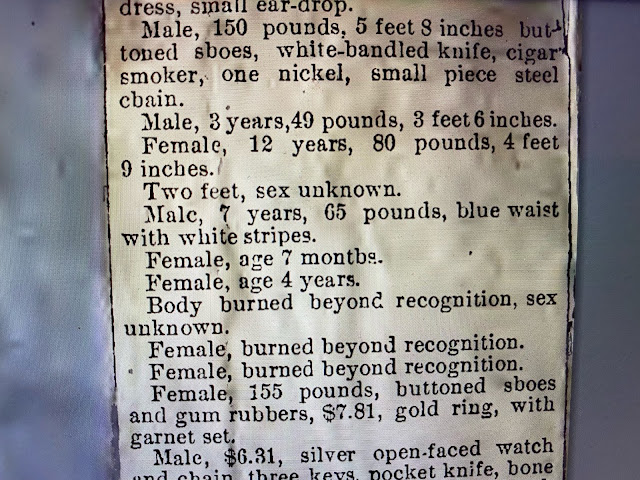


These articles are the gut wrenching to me.


The Plot of the Unknown in Grandview Cemetery


Some facts that were published about this flood:

  • 99 entire families were killed including 396 children.
  • 124 women and 198 men were widowed
  • Bodies were found 400 miles away in Cincinnati
  • Bodies were found from the flood up into the year 1911
  • 1600 homes were destroyed
  • 4 square miles of Johnstown were destroyed
  • Clara Barton the founder of the America Red Cross arrived on June 5th to Johnstown for the first major peace time disaster relief effort for the American Red Cross.
  • More than 750 victims were buried at the Plot of the Unknown in Grandview Cemetery.

Below is a link to a YouTube video called "The Johnstown Flood- What it looks like 131 years later." by Chris of Mobileinstinct. He does a good job of touring the site of the flood. You will have to cut and paste the link on your search bar. 

https://youtu.be/uCALCe3-lhk


 At the time of the flood my 3 times Great Grand Mother Charlotte Heslop was living with her son in the Johnstown downtown district on Vine Street. She was in the home when the water hit the city and was one of the lucky citizens to survive.  She did have to be rescued from the home by raft, but there was no information on what condition the house was in, if it was on its foundation, or where in the house she was rescued from. When researching her husband James I found that his grave and many graves of the soles that were resting in the Sandyvale Cemetery in Johnstown no longer had head stones because they were washed away by the flood. 

Charlotte moved to Middleport, Ohio in September of 1893, where she lived with her Daughter Mary and Eli Russell, my  Great, Great Grandparents. She fell shortly after the move and broke both hip bones. She died on November 4, 1895. Charlotte was a charter member of the Episcopal Church in Johnstown when it was organized in 1836. She was brought back to Johnstown to be interned near her husband in Sandyvale Cemetery.

The Sandyvale Cemetery is now called the Sandyvale Memorial Gardens. There have been three major floods in Johnstown, 1899, 1936 and 1977 and less than 200 gravestones remain from the estimated 6000 burials. Many people had been re-interred to other cemeteries on higher ground. The flood of 1936 destroyed all the records so, there was no way to place any of the headstones on the proper graves. The last burial in the cemetery was in 1977. At the Sandyvale Memorial Gardens all the remaining headstones displaced by all three floods are now assembled in a group of Memorial Beds next to the Sandyvale Trail. A sign/marker in Sandyvale reads, "Interred here in Sandyvale are Abolitionists: William Slick, Benhamin Slick, John Cushon, James and Charlotte Heslop.


The Memorial Bed of the displaced headstones. 

I have found no trace of my Grandparents home that they used for the Underground railroad and my assumption is that by the time it would have been labeled as a historic site, the house was no longer standing and could have even been destroyed by any of the floods.

I hope you enjoyed the history of my amazing 3 times grandparents, and that you will look further into the history of the Underground Railroad and the Johnstown Flood of 1889. There are so many individual stories on the flood that are so amazing and stories of the brave men and women that fought for the end of slavery before the Civil War. 


Friday, May 7, 2021

Artisan to Abolitionist: Part 2, The Underground Railroad

When we last left our Heroes James and Charlotte Heslop, James retired from the wallpaper and painting business in Johnstown, PA in 1853. In a book about the History of Cambria County, PA this is how they started the section on James and Charlotte Heslop and their retirement years. "During the several years immediately preceding the Civil War he (James) took an earnest part in the general agitation of the slavery question, and arrayed himself clearly and firmly on the side of those who bitterly opposed it. Indeed he was one of the rankest Abolitionists in all the region, and held in utter contempt any measure; that tolerated traffic in human beings, white or black."

The Heslop's political leanings were first with the Whig party and when the Whig party collapsed  in 1854 they joined the anti- slavery Republican party. The Heslop's used their comfortable home as a station on the Underground railroad and they were conductors. They would hide runaway slaves in the attic of their home, an abandoned mine on their land and in a cellar dug under the horse stable. The door of the cellar was under the horse stall covered by hay and the horses.  

It was a dangerous business to hide fugitive slaves. Pennsylvania was the first free state north of the Mason Dixon line and bordered the slave state of Maryland. With the passing of the National Fugitive Slave Acts in 1793 and 1850 requiring free states to return fugitive slaves, and the later act requiring officials to assist in the recapture of fugitive slaves, it made their work even more dangerous. The Act also established a six month prison term and $1000 fine for anyone assisting the fugitive slaves. That didn't stop the Abolitionist community in Johnstown from protecting runaways by joining the Underground railroad in defiance of the laws. This came with personal risks for the individuals that were conductors of the railroad with the state being barraged with slave catchers where no home was safe from their searching parties with the law on their side. They were brazen in their pursuit and would raid private homes and property and even offer compensation for information on the location of the fugitive slave. They would also kidnap free black citizens and take them back to their states and sell them into slavery. James and Charlotte's home was frequently visited and searched by slave hunters, but not one was ever found or taken while at their station. They would aid, feed and house fugitive slaves and then send them safely to more friendly regions north where the slave hunters would not follow.


A US map of the many routes taken by slaves to freedom


I found this story in the book of the History of Cambia County, Pennsylvania, by Henry Wilson Storey, published in 1907. The story about my 3 times great grandparents is a testament as to how strong their abolitionist convictions were, especially Charlotte, and was told with a bit of humor on a subject that is not in the least bit humorous.
HISTORY OF CAMBRIA COUNTY.

After the repeal of the Missouri Compromise, which was substantially done in the famous compromise of 1850, an incident occurred in Johnstown which discloses strong conviction and decision of character, with a beautiful sentiment expressed by Mrs. James Heslop, who as well as her husband was an Abolitionist. An escaping slave had reached this town and had been 
secreted in Cushon's coal bank, under Green Hill, by John Cushon and other agents of the Underground Railroad. Soon thereafter, while Mr. and Mrs. Heslop were sitting in their room on the second floor, a knock was heard at the front door. It was about dusk, and Mr. Heslop, going to the door, became engaged in conversation with the visitor, which continued for some time. Mrs. Heslop, being acquainted with the escape, divined the matter to which the conversation 
related. Going to the top of the stairs she heard the visitor pleading with her husband to tell him where the fugitive was, and offering him twenty-five dollars for the information. Still Mr. Heslop denied any knowledge of the affair. Hearing the offer increased to seventy dollars, she descended the stairway, quietly walked to the door and closed it. In referring to it to a friend she 
mildly said: "I was afraid James might be tempted."
James and Charlotte were conductors on the Underground Railroad until James' death in 1865. He passed a few months after the start of the Civil War. He did not live to see the emancipation of slaves. 
In the next part of Artisans to Abolitionist I will tell the continuing story of Charlotte Heslop in her later years. 


Grandma's Quilt

  My Paternal Grandma was a quilter. I mean a hardcore, full size, wood frame, hand sewn quilter. I remember as a kid in the 60s and 70s goi...