I saw a website that had the best children's hide-n-seek hiding places. There were pictures of kids behind curtains where their legs aren't covered, and there was even a kid standing behind a skinny pole. Young kids think that if their eyes are covered and they can't see you, that you in turn can't see them.
My Grandkid's ages are one and three, and here are their best hiding attempts. First, our one year old granddaughter. She has no concept of hiding past peek-a-boo. The first picture is her hiding in plain sight. She can't see us, so of course we cannot see her.
This second picture was her first attempt to hide inside something. Unfortunately she does not understand that the hiding place would be better if it had sides, lol. Not bad for a one year old though. It also doesn't help that once she was successful getting in her hiding place she would scream with excitement.
Now, our three year old grandson has the right idea to hid behind something, but needs to be a little more thoughtful on what you hide behind. I think his thought process in this first picture was if you hide behind something and close your eyes then you are invisible to everyone else.
In this next picture he was getting a little better at hiding most of his body. Once his head was under the chair he must have thought he then became invisible.
I love this next picture where he put his face right up against the table leg. He couldn't see me, so of course I couldn't see him. The best part was that when I showed him the picture he said,"Meemaw, I can still see part of my eye!" He didn't notice the rest of his body showing, or that his little hand is on the outside of the table leg for all to see. So, if I can't see his eyes, he is invisible. Right?
This last picture is by far my favorite. He had the right idea this time. He is completely covered on all sides, but there is just one small problem, the storage bin is clear. How cute is that boy?
Tuesday, August 23, 2016
Tuesday, August 16, 2016
A Summer Trip to the Dallas Arboretum
It was a beautiful Texas July day with the temperature predicted to hit 100 degrees. Not the best day to be outside at the Dallas Arboretum, but we went anyway. We arrived as they were opening, and wanted to stay for an hour or so to get some Summer pictures. We had visited the Arboretum in the late Fall, so we were excited to see all the summer colors. The temp was in the high 80s when we arrived, so we knew it would be a short trip.
The Arboretum was not very busy, but I was surprised at the number of people that paid the admission cost to run around playing Pokemon Go. It was sad to me that they were not even enjoying the beauty of the grounds, just staring at their phones the whole time.
Here are some of the pictures we took that morning:
The Arboretum is a must stop if you are ever in Dallas!
The Arboretum was not very busy, but I was surprised at the number of people that paid the admission cost to run around playing Pokemon Go. It was sad to me that they were not even enjoying the beauty of the grounds, just staring at their phones the whole time.
Here are some of the pictures we took that morning:
| This statue is one of my favorites in the park. |
| The water features are everywhere and beautiful. The running water sounds are awesome. |
| Another great water feature! |
| There are many different types of Elephant Ear plants. |
| The walkways are stunning! |
| These water lilies are in pots in the bottom of the Koi pond. |
| Beautiful Lily pads in this pond. |
| Lily pads up close. |
| One of the many gardens. |
| Infinity pool that looks out to the White Rock Lake. |
| Close up picture of the Crape Myrtle canopy. |
| Outside of the Crape Myrtle Canopy and the section of the park where they grow the plants. |
| Inside of the Crape Myrtle Canopy. There is a kids spray area at the end. |
Tuesday, August 9, 2016
The Maligned Cargo Shorts
When my sons were in their teens they gave my husband a hard time about wearing jean shorts (jorts). They had him start wearing khaki cargo shorts. That was the beginning of a beautiful relationship between my husband and cargo shorts.
Then several years ago our kids started giving him a hard time about wearing cargo shorts. The push now is the flat or pleated front above the knee shorts. So, we bought the new shorts to add to his "Kid Approved" wardrobe, but the cargo shorts stayed.
Last August we received an email from our daughter. The Subject: Just say no. The body of the email said: For dad, from (name of our youngest son). I am not sure if that was true, or if she was just blaming it on her little brother. Attached to the email was the link to an article on BuzzFeed, by Pablo Valdvia titled: " Dear Men, Please Stop Wearing Cargo Shorts." The article showed pictures of men in cargo shorts and how it was a disease taking over the world. Then the article went on to show pictures of men in "regular" shorts as a way to show cargo short loving men the light, and a way to better fashion.
This did not sway my husband away from his beloved cargo shorts. Now he does wear "regular" shorts most of the time, but there are days and events when nothing can replace a good pair of cargo shorts.
Then last week a Wall Street Journal writer named Nicole Hong wrote a humorous article that probably got more attention than she anticipated. The article printed on Aug 1st was titled: "Nice Cargo Shorts! You're Sleeping on the Sofa." The article was about the men who love their cargo shorts and the women who hate them, (the shorts, not the men).
My husband sent the article to all our kids with the the Subject: Long live cargo shorts!
My daughter responded with, " Cargo shorts can stay as long as we promise not to bring back cargo pants."
Then on Friday Aug 5, Nicole Hong had a follow up article on all the controversy surrounding her first article on the 1st. This one was titled: "What Happened After I Wrote That Cargo Short Story." I found this article hilarious. Hong wrote the following paragraph, "Since the story published on the Wall Street Journal's website Monday afternoon, it has devoured all the attention that was previously fixated on the election. The story has dominated the Journal's web traffic for most of the week." She had no idea what she was messing with when she took on men and their cargo shorts. These are both fun articles that you should check out.
New email to the kids from my husband with Aug 5th article attached, Subject: The cargo shorts debate rages on!
On the same day, Aug 5th, an article was published in the Washington Post covering the now ever popular subject of cargo shorts. This article written by Christopher Ingraham was titled: "Map: Real American Men Don't Wear Cargo Shorts". The article covers the debate between cargo shorts and jorts by geographical locations. The map in the article is titled: "The Great Short Divide". This article is very funny and the maps show by state the preference of either cargo shorts or jorts. I also recommend that you check out this article. Although, I will tell you that Mr. Ingraham was surprised that his Twitter followers overwhelmingly preferred cargo shorts to jorts.
I have always stayed out of the cargo shorts debate in our family, but have decided to end my silence. First a little background. I have lived my life as an adult woman carrying a purse. When my kids were young it was a purse and a diaper bag. I referred to myself as the family pack mule. When the diaper bag went away, the purse got bigger, and at times the purse was a backpack. When the kids were all grown up I tried to downsize, but I always ended up carrying my husband's items in my purse. Sunglasses case, inhaler, wallet, tissues, ............ Then like a ship out of the night.....Cargo Shorts! Pockets for all his stuff! No more pack mule. Yippee!!!!
So, my grateful back and shoulders are happy for the weight reduction in my purse. Fashion may have taken a back seat in our Kid's eyes, but I agree with my husband.
LONG LIVE CARGO SHORTS!!!!!!!!
Then several years ago our kids started giving him a hard time about wearing cargo shorts. The push now is the flat or pleated front above the knee shorts. So, we bought the new shorts to add to his "Kid Approved" wardrobe, but the cargo shorts stayed.
| My husbands closet shelf of shorts. The top two and bottom right stacks are all cargo shorts. |
| "Regular" shorts |
This did not sway my husband away from his beloved cargo shorts. Now he does wear "regular" shorts most of the time, but there are days and events when nothing can replace a good pair of cargo shorts.
Then last week a Wall Street Journal writer named Nicole Hong wrote a humorous article that probably got more attention than she anticipated. The article printed on Aug 1st was titled: "Nice Cargo Shorts! You're Sleeping on the Sofa." The article was about the men who love their cargo shorts and the women who hate them, (the shorts, not the men).
My husband sent the article to all our kids with the the Subject: Long live cargo shorts!
My daughter responded with, " Cargo shorts can stay as long as we promise not to bring back cargo pants."
Then on Friday Aug 5, Nicole Hong had a follow up article on all the controversy surrounding her first article on the 1st. This one was titled: "What Happened After I Wrote That Cargo Short Story." I found this article hilarious. Hong wrote the following paragraph, "Since the story published on the Wall Street Journal's website Monday afternoon, it has devoured all the attention that was previously fixated on the election. The story has dominated the Journal's web traffic for most of the week." She had no idea what she was messing with when she took on men and their cargo shorts. These are both fun articles that you should check out.
New email to the kids from my husband with Aug 5th article attached, Subject: The cargo shorts debate rages on!
On the same day, Aug 5th, an article was published in the Washington Post covering the now ever popular subject of cargo shorts. This article written by Christopher Ingraham was titled: "Map: Real American Men Don't Wear Cargo Shorts". The article covers the debate between cargo shorts and jorts by geographical locations. The map in the article is titled: "The Great Short Divide". This article is very funny and the maps show by state the preference of either cargo shorts or jorts. I also recommend that you check out this article. Although, I will tell you that Mr. Ingraham was surprised that his Twitter followers overwhelmingly preferred cargo shorts to jorts.
I have always stayed out of the cargo shorts debate in our family, but have decided to end my silence. First a little background. I have lived my life as an adult woman carrying a purse. When my kids were young it was a purse and a diaper bag. I referred to myself as the family pack mule. When the diaper bag went away, the purse got bigger, and at times the purse was a backpack. When the kids were all grown up I tried to downsize, but I always ended up carrying my husband's items in my purse. Sunglasses case, inhaler, wallet, tissues, ............ Then like a ship out of the night.....Cargo Shorts! Pockets for all his stuff! No more pack mule. Yippee!!!!
So, my grateful back and shoulders are happy for the weight reduction in my purse. Fashion may have taken a back seat in our Kid's eyes, but I agree with my husband.
LONG LIVE CARGO SHORTS!!!!!!!!
Wednesday, August 3, 2016
Decorating a Texas Size Fireplace
When we bought our house in Texas it came with a Texas size stone fireplace. The only thing I knew for sure about decorating the fireplace was that I was going to hang a picture on it that I brought with us from Virginia. The picture is very modern and the colors were perfect in the room. The rest of the room is very eclectic and a great mix of modern, traditional and earthy (for lack of another word). For months the picture was hung on the fireplace, but the only other items on the hearth were two large plants, one on each side.
The colors of the family room are red, orange, a muted lime green, and a dark brown. All these colors were in the fabric that I updated our drapes with, that also matched one of our chairs. Now, I wanted to bring those colors into the decorations on the fireplace.
This fireplace has two small ledges on each side of the hanging picture and then a large mantel. The hearth is a large ledge and is about two feet off the ground. I thought at first that on the small ledges I would get some faux topiaries, but I could not find any I liked. I did find some faux plants in textured tan and brown pots at Home Goods. They were just the right height too!
While I was at Home Goods I found a large Mexican bottle/vase that was a beautiful mixture of brown, red and orange, and a wicker basket with an interesting design and handles. These will dress up the hearth. In the basket I draped a knit throw and added a pillow that has my childhood home address on it. The pillow was a wonderful gift from my sisters.
My last purchase at Home Goods was a modern orange birdcage. It is not easy to find items in the perfect shade of orange, so this was a great find for my mantel.
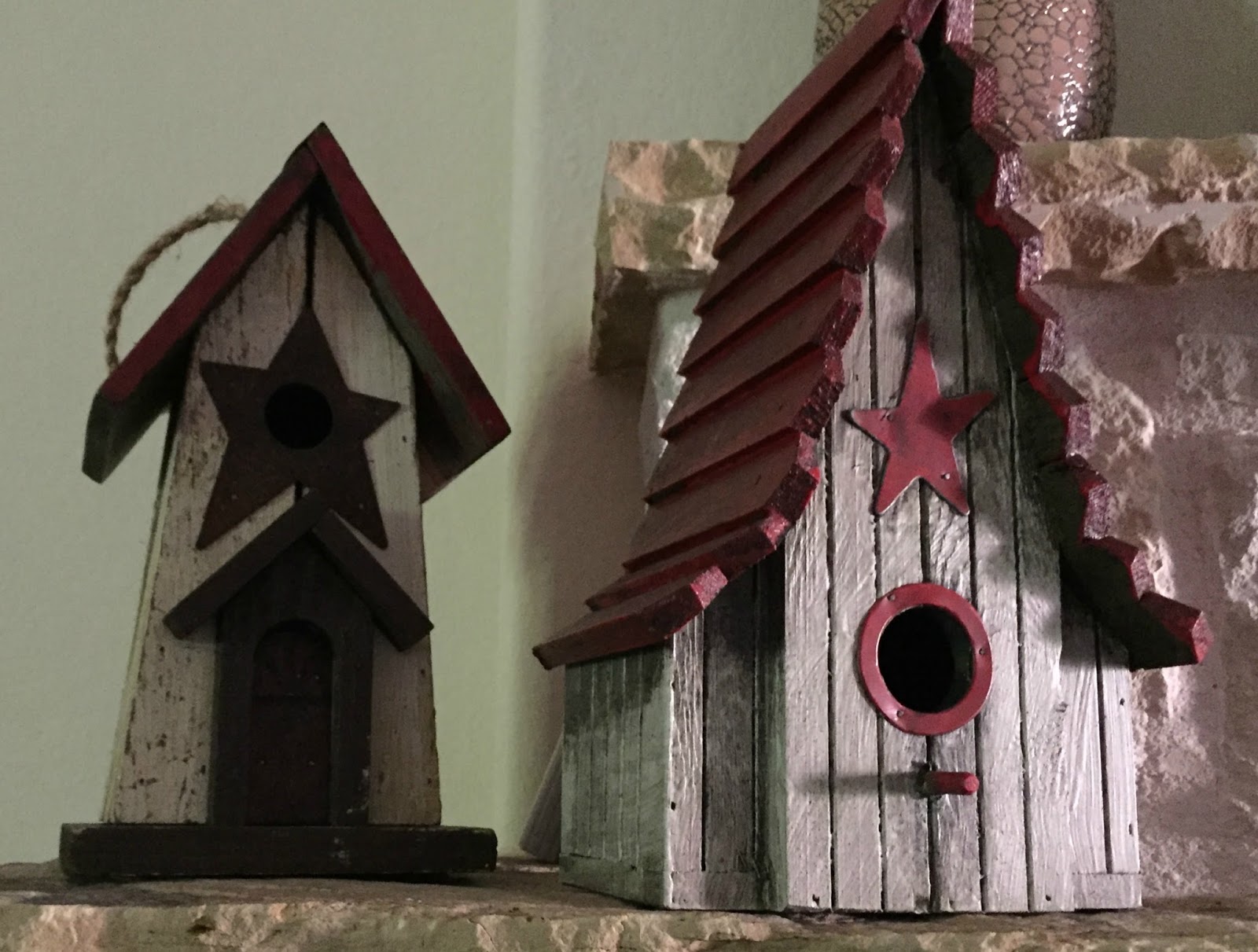
On a trip to Hobby Lobby I found two wood birdhouses and both had a star on them that reminds me of Texas. These houses will go perfectly on the mantel.
My last purchase was a colorful wood bird wearing a hat that I purchased at a local antique shop while shopping with my visiting sisters. This bird was the perfect complement to the orange birdcage, and put some fun into the grouping for the mantel.
The change in the fireplace is dramatic. I truly love the mixture of color and styles. The modern and earthy eclectic decor mix works well together.
I never tire of looking at my fireplace, and it always makes me smile!
| The picture was our starting point. |
| This is the colorful chair that now matches our drapes. |
This fireplace has two small ledges on each side of the hanging picture and then a large mantel. The hearth is a large ledge and is about two feet off the ground. I thought at first that on the small ledges I would get some faux topiaries, but I could not find any I liked. I did find some faux plants in textured tan and brown pots at Home Goods. They were just the right height too!
| The pots are a nice texture and color and the size of the plant is perfect. |
| The colors on this jar matches the room perfectly. |
| I received this pillow from my sisters after their visit. The numbers are the house numbers of our childhood home. It had to be displayed prominently in my house. |
| I love the kind of modern and Asian look. |
| For some reason in this house I am using birdcages and birdhouses. They are something new to me and I really like them. Which is funny because I hate birds, thanks to Alfred Hitchcock. |
| Too bad all birds can't look this cute and non-threatening. |
I never tire of looking at my fireplace, and it always makes me smile!
Wednesday, July 27, 2016
Civil War Family History
There is a story that my maternal Aunt tells about one of my Grandfathers being a doctor during the Civil War. So, since I have been working on my Ancestry for a few years now, I thought I would try to find this Grandfather. No luck! What I did find was my Great Great Great Step-grandfather John Hysell and my Great Great Grandfather Eli Russell.
Eli was born in 1834 to Robert and Nancy Russell. My Great Great Great Grandfather Robert died in 1845 at the age of 43, leaving behind a wife and 8 kids. The oldest boy, and their 4th child, was Eli at 9 years old. The next time I found Eli in the National Census was in 1850 when he was 16 and living with his Mom, Nancy, and Stepfather John Hysell, a man about 8 years her junior. Go, Great Great Great Grandma Nancy!
My Great Great Great Step-grandfather, John Hysell, enlisted into the 75th Regiment, H company, of the Ohio Volunteer Infantry on November 7, 1861 to fight in the Union Army, and was to serve 3 years. He was 40 years old at the time. At this time, and until the Enrollment Act or Civil War Military Draft Act was enacted on March 3, 1863, the Union Army was an all volunteer army.
On May 8 1862 John fought in the Battle of McDowell, which was also know as the Battle at Sitlington's Hill. This battle was a loss for the two Union Army brigades of Major General Fremont's, lead by Brig General Schnek and General Milroy. John was under the command of Milroy during this battle.
In the battle of McDowell/ Sitlington's Hill the Union soldiers pressed forward towards Confederate troops lead by Stonewall Jackson, who had twice as many men, and controlled the higher ground. Milroy drove his troops up the hill to engage the Confederates and after four hours, from about 4:30 in the afternoon until about 8:30 PM, of intense fighting the Union troops retreated back to the town of McDowell.
John was in one of the companies that went up the hill first and he died from wounds he received during that battle. He was only a Union soldier for 6 months. I was unable to find his final resting place, so I am assuming that he was buried in a marked mass grave on the battlefield.
My Great Great Great Grandmother Nancy Russell Hysell was widowed once again.
My Great Great Grandfather Eli married Mary Hesslop in 1854, and had 5 kids, when he enlisted into the 91st Regiment, H company of the Ohio Volunteer Infantry on Aug 8, 1862. I can only imagine how hard it was for Mary being left behind with babies of ages ranging from infant to seven years old. Not to mention that Nancy, his mother, must have been beside herself with worry seeing a son go off to war just a few months after losing her husband to that same war.
In May of 1864 my Grandfather Eli, well into his second year of service, was one of 6100 soldiers serving under General George Crook. Among the soldiers from Ohio in this group were two future presidents, Colonel Rutherford B. Hayes and Major William McKinley. My Grandfather Eli served with these two men.
The union army was working their way through western Virginia destroying salt mines, lead mines and railroads. They also were trying to draw the Confederates away from western Virginia. There were a few Confederate units left in the area led by Confederate Brigadier General Albert G. Jenkins who set up a defensive position in Pulaski County at Cloyd's Mountain.
On May 9, 1864 at about 9 AM some small skirmishes started at Cloyd's Mountain, and Crook recognized that the Rebel position was too strong for a frontal assault. Crook decided to instead strike from the right flank of the Rebels position.
The battled started at about 11 AM and lasted only one hour. This battle was exceptionally violent because most of the fighting was hand to hand combat. Some soldiers stated that it was not the greatest, or most important battle of the war, but for fierce and deadly intensity Cloyd's Mountain exceeded them all. If the fighting was not violent enough, gunfire ignited dry leaves on the battlefield starting a fire that burned everything and everyone in its path. Many active and wounded soldiers were burned to death in this fire. Among the wounded that escaped the fire was the Confederate leader Jenkins. He died later of complications from having his arm amputated. Some stories say that the bandages came loose, or were knocked off by a medical assistant, from his arm and he bled to death. I am not sure if that story is true, but it certainly was possible.
The Union was victorious at Cloyd's Mountain, but casualties for both sides were extremely high for the small size of the troops involved. Eli was wounded in this battle. He must have been treated and eventually returned to duty, because he was not mustered out of service until June of 1865.
It was a miracle that he survived the war to begin with, but especially after being wounded. Of the estimated 620,000 men that died in the Civil War, most were not from battle wounds. About 413,000 died from diseases, of which the number one killer was dysentery. If trying to survive the enemy was not enough soldiers had to worry about Typhoid, Ague (swamp fever), Yellow Fever, Malaria, Scurvy, Pneumonia, Tuberculosis, Smallpox, Chicken Pox, Scarlet Fever, Measles, Mumps and Whooping Cough. The soldiers had to contend with many issues that contributed to the spread of disease like, poor hygiene, garbage in the camps, contaminated water supplies, overcrowding, exposure, spoiled food, bugs, and lack of medical personnel. I had a Great Great Grandfather named Adam Swinehart that was in the Ohio 176 Infantry for about 10 months at the end of the war. His unit was stationed as a sort of guard unit in Nashville. Adam's company saw no action yet they lost 102 men, all to disease.
Eli was lucky to not have contracted a disease, but even more lucky that the treatment of his wounds in battle did not kill him. Eli was also lucky that he was wounded closer to the end of the war because the medical staff of the Union army was increased and improved over the years of the war. In late 1862 there was finally a type of ambulance system put in place. Men were treated close to the fighting, the wounds were packed with lint (scraped from linen fabric), bandaged as best they could, given morphine for pain, maybe given some whiskey for shock and then taken by "ambulance" to a field hospital. This would have been in a nearby tent, barn or house. If you made it that far you then were treated by someone who may, or may not have had any medical training, or someone who just "considered" themselves a physician. Many doctors worked with a copy of a military surgery manual to use for directions as they treated soldiers.
Many Civil War doctors did not understand germs, or how they were spread. Many thought pus was a positive sign and were not very careful to not spread the infection from one wounded man to another. Instruments were not sterilized and surgeons did not wash up between patients. Most of the soldiers wounds were to the arms or legs, and the surgeons believed that the best chance of the soldiers survival was to amputate.
I am not sure of the exact wound my Great Great Grandfather Eli sustained, but from pictures of him after the war where he is holding a cane, I am guessing he was wounded in the leg. Eli was that lucky one in four that survived the war, and even luckier to have survived his wound. Above all he returned home to his family that grew to 12 kids, and to his mother Nancy who had already suffered so much loss.
I may not have found the elusive Grandfather that was a doctor in the Civil War, but I did find a Great Great Great Step-Grandfather and Great Great Grandfather that in my eyes were Civil War Heroes! Both volunteered to serve in this countries deadliest war to fight for a cause they believed in. One gave his life for that cause, and the other was wounded in one of the most brutal battles of the war. Both of these Grandfather's stories make me proud to be their Granddaughter.
Eli was born in 1834 to Robert and Nancy Russell. My Great Great Great Grandfather Robert died in 1845 at the age of 43, leaving behind a wife and 8 kids. The oldest boy, and their 4th child, was Eli at 9 years old. The next time I found Eli in the National Census was in 1850 when he was 16 and living with his Mom, Nancy, and Stepfather John Hysell, a man about 8 years her junior. Go, Great Great Great Grandma Nancy!
My Great Great Great Step-grandfather, John Hysell, enlisted into the 75th Regiment, H company, of the Ohio Volunteer Infantry on November 7, 1861 to fight in the Union Army, and was to serve 3 years. He was 40 years old at the time. At this time, and until the Enrollment Act or Civil War Military Draft Act was enacted on March 3, 1863, the Union Army was an all volunteer army.
On May 8 1862 John fought in the Battle of McDowell, which was also know as the Battle at Sitlington's Hill. This battle was a loss for the two Union Army brigades of Major General Fremont's, lead by Brig General Schnek and General Milroy. John was under the command of Milroy during this battle.
| This is a map from the Civil War Preservation Trust showing the location of the battle and the troop. John Hysell was in one of the two groups I have circled in red. |
| Current picture of the battle location. |
| Across the road in the pasture was where the Union forces had their camp in plain view of the Confederate forces on the hill in the back of the picture. The Union troops moved to safer ground. |
| This may be the only headstone marking my Great Great Great Step Grandfather's final resting place. |
My Great Great Grandfather Eli married Mary Hesslop in 1854, and had 5 kids, when he enlisted into the 91st Regiment, H company of the Ohio Volunteer Infantry on Aug 8, 1862. I can only imagine how hard it was for Mary being left behind with babies of ages ranging from infant to seven years old. Not to mention that Nancy, his mother, must have been beside herself with worry seeing a son go off to war just a few months after losing her husband to that same war.
In May of 1864 my Grandfather Eli, well into his second year of service, was one of 6100 soldiers serving under General George Crook. Among the soldiers from Ohio in this group were two future presidents, Colonel Rutherford B. Hayes and Major William McKinley. My Grandfather Eli served with these two men.
The union army was working their way through western Virginia destroying salt mines, lead mines and railroads. They also were trying to draw the Confederates away from western Virginia. There were a few Confederate units left in the area led by Confederate Brigadier General Albert G. Jenkins who set up a defensive position in Pulaski County at Cloyd's Mountain.
| An Original drawing of the Battle of Cloyd's Mountain from the Virginia Historical Society. |
| This is a picture taken in the 1970s of the same location in the drawing above. |
The battled started at about 11 AM and lasted only one hour. This battle was exceptionally violent because most of the fighting was hand to hand combat. Some soldiers stated that it was not the greatest, or most important battle of the war, but for fierce and deadly intensity Cloyd's Mountain exceeded them all. If the fighting was not violent enough, gunfire ignited dry leaves on the battlefield starting a fire that burned everything and everyone in its path. Many active and wounded soldiers were burned to death in this fire. Among the wounded that escaped the fire was the Confederate leader Jenkins. He died later of complications from having his arm amputated. Some stories say that the bandages came loose, or were knocked off by a medical assistant, from his arm and he bled to death. I am not sure if that story is true, but it certainly was possible.
![]() |
| Historical marker at Cloyd's Mountain. |
The Union was victorious at Cloyd's Mountain, but casualties for both sides were extremely high for the small size of the troops involved. Eli was wounded in this battle. He must have been treated and eventually returned to duty, because he was not mustered out of service until June of 1865.
It was a miracle that he survived the war to begin with, but especially after being wounded. Of the estimated 620,000 men that died in the Civil War, most were not from battle wounds. About 413,000 died from diseases, of which the number one killer was dysentery. If trying to survive the enemy was not enough soldiers had to worry about Typhoid, Ague (swamp fever), Yellow Fever, Malaria, Scurvy, Pneumonia, Tuberculosis, Smallpox, Chicken Pox, Scarlet Fever, Measles, Mumps and Whooping Cough. The soldiers had to contend with many issues that contributed to the spread of disease like, poor hygiene, garbage in the camps, contaminated water supplies, overcrowding, exposure, spoiled food, bugs, and lack of medical personnel. I had a Great Great Grandfather named Adam Swinehart that was in the Ohio 176 Infantry for about 10 months at the end of the war. His unit was stationed as a sort of guard unit in Nashville. Adam's company saw no action yet they lost 102 men, all to disease.
| House used as a Field Hospital for the battle of McDowell. |
![]() |
| House used at Cloyd's Farm as a Field Hospital. |
I am not sure of the exact wound my Great Great Grandfather Eli sustained, but from pictures of him after the war where he is holding a cane, I am guessing he was wounded in the leg. Eli was that lucky one in four that survived the war, and even luckier to have survived his wound. Above all he returned home to his family that grew to 12 kids, and to his mother Nancy who had already suffered so much loss.
![]() |
| Great Great Grandfather Eli B. Russell |
Tuesday, July 19, 2016
A Window with a History
A few years ago when I was living in Virginia I was looking for an old window to use as a bed headboard. I found some windows at an antique store that we were told were from the original Washington National Airport, currently Reagan National. The windows were from the 1940s. I purchased two of these windows and took them back to our house in Virginia where they sat for a long while on our patio. These windows were a constant bone of contention between me and my husband. He hated those windows for a few reasons, first they smelled musty, and second they were covered in peeling lead paint. Two really good reasons, but I loved them and was determined to use them in our home, safely.
The first thing I did was research on how to strip off the lead paint. I knew I could not sand them because the lead would be in the dust and I could breath it. I ended up using a paint stripper, and with a paint respirator I safely stripped off the dangerous lead paint. Unfortunately, after stripping them the windows sat on the patio for a few years while we were living in temp housing in Texas trying to sell the house in Virginia.
Against my husbands misgivings I had the windows packed and moved to Texas. Before they were packed I realized that the glass was not going to stay in place and removed the glass from both windows before they were packed. When they made it to Texas I decided to only keep one of the windows and threw the second one away. Happy Husband!
Now, I had to decide what to do with the remaining window. I thought about painting it and using the pane sections for pictures. Or, maybe paint it, add some hooks, and hang it outside for beach towels. Then I thought I would use it outside as part of a planter. So, this is what I did with a lot of help from my husband, surprisingly enough.
First, I measured between the handles at the bottom of the window, and bought a wood flower box that would fit in between the handles. I also bought some polyurethane to seal and waterproof the window, and some large bolts to attached the flower box to the window.
Next I put a coat of polyurethane on both sides of the window. I wanted to keep the original patina of the window, but protect it from the weather.
My next step would have been to bolt the box to the window, but my husband analyzed my plan and realized that it wouldn't hold the box in place, and it would require drilling holes into an old window that may not be able to take it. So, after much thought we came up with a plan and went off to Home Depot to get our supplies. We bought a deck window box kit, 3 horseshoe clamps (the type that holds a pipe against a wall) and 3 heavy duty rafter hangers.
Once we had the supplies My husband put the project together while I was swimming with my Grandson. I definitely got the better end of that deal, right?
First he used the hooks from the deck flower box kit and screwed them into the back lower section of the flower box. We used these hooks to hang the box onto the bottom of the window frame.
Because the box would have fallen forward with just the hooks on the bottom holding to the window, he put the horseshoe clamps at the top of the box and used them to hold it against the window frame. He put a felt pad on the inside of the clamp to protect the frame from the metal clamp.
We decided to hang the window flower box on the fence behind the pool using the rafter hangers.
I picked English Ivy to plant in the flower box in hopes it will grow up, around, and through the window frame like a trellis.
The best part of this creation of ours is that it is not only a piece of history but, my Husband loves it!
Against my husbands misgivings I had the windows packed and moved to Texas. Before they were packed I realized that the glass was not going to stay in place and removed the glass from both windows before they were packed. When they made it to Texas I decided to only keep one of the windows and threw the second one away. Happy Husband!
| The surviving window stripped and ready for polyurethane. |
First, I measured between the handles at the bottom of the window, and bought a wood flower box that would fit in between the handles. I also bought some polyurethane to seal and waterproof the window, and some large bolts to attached the flower box to the window.
| Wood flower box I bought at Lowes. |
| I added a coat of Poly to protect the raw wood from the weather. |
| Here are our supplies, three large rafter hooks, 3 horseshoe clamps, 2 hooks from the deck flower box kit, and some screws to hold it all together. |
First he used the hooks from the deck flower box kit and screwed them into the back lower section of the flower box. We used these hooks to hang the box onto the bottom of the window frame.
| Hook screwed into the bottom of the flower box. |
| Both hooks are in place and attached to the window frame. |
| The horseshoe clamp was padded, put around the frame and then screwed into the top back of the flower box. |
| All three horseshoe clamps are in place. |
I picked English Ivy to plant in the flower box in hopes it will grow up, around, and through the window frame like a trellis.
The best part of this creation of ours is that it is not only a piece of history but, my Husband loves it!
Subscribe to:
Posts (Atom)
Grandma's Quilt
My Paternal Grandma was a quilter. I mean a hardcore, full size, wood frame, hand sewn quilter. I remember as a kid in the 60s and 70s goi...
-
My 4 times Great Grandfather Peter Humbarger Sr. was a first generation American, born in Berks Co., PA in 1766. He moved his family in 1802...
-
Go Stars!! I can never find a button down shirt/blouse, or a long t-shirt that fits me well. If the shirt fits in the shoulders, ...
-
On all of our drives into the country in Texas I have been fascinated with the entrance gates to the ranches and fields. To me they are so u...